
Last updated September 10, 2026
Full 25-point door and opener safety check with every visit - springs, cables, rollers, tracks, and your LiftMaster or Chamberlain opener included
You get a price before we start. It does not change when the truck arrives.
 Before
 After
After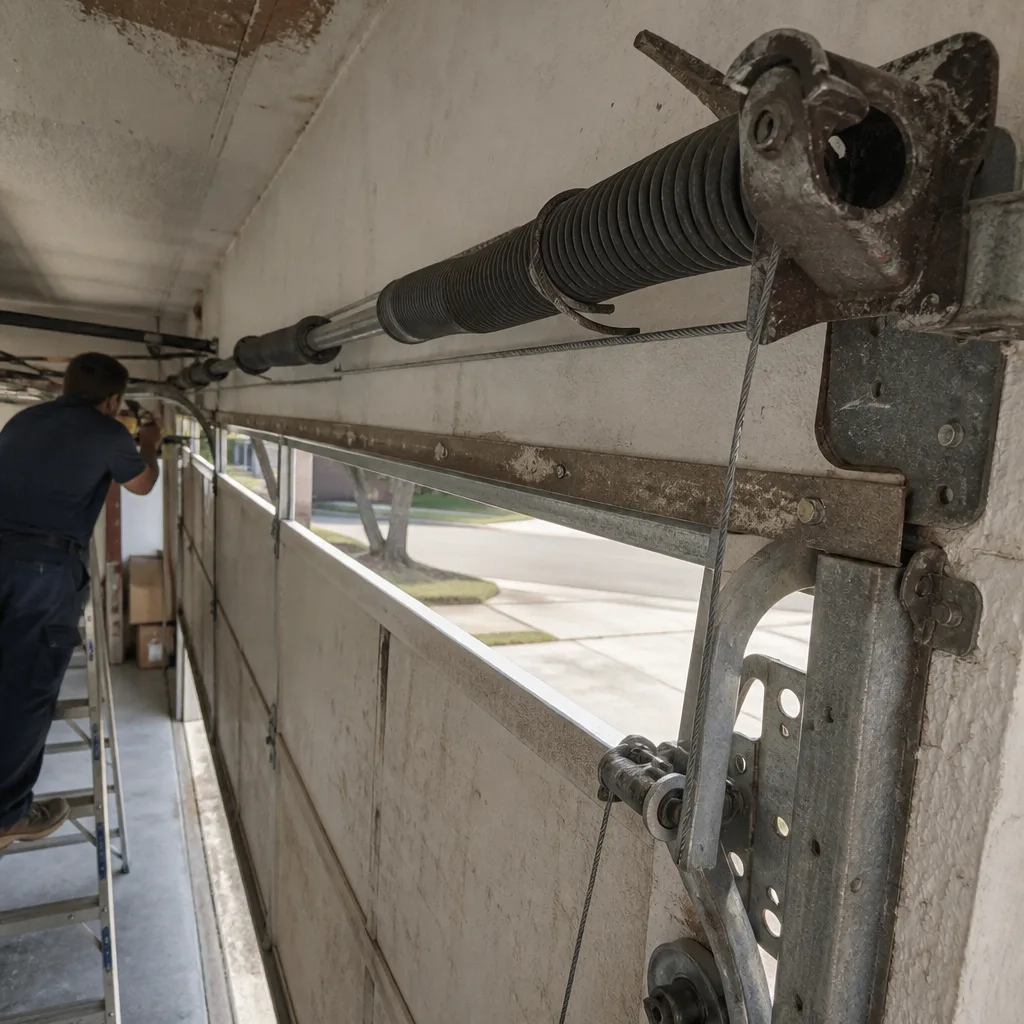 Before
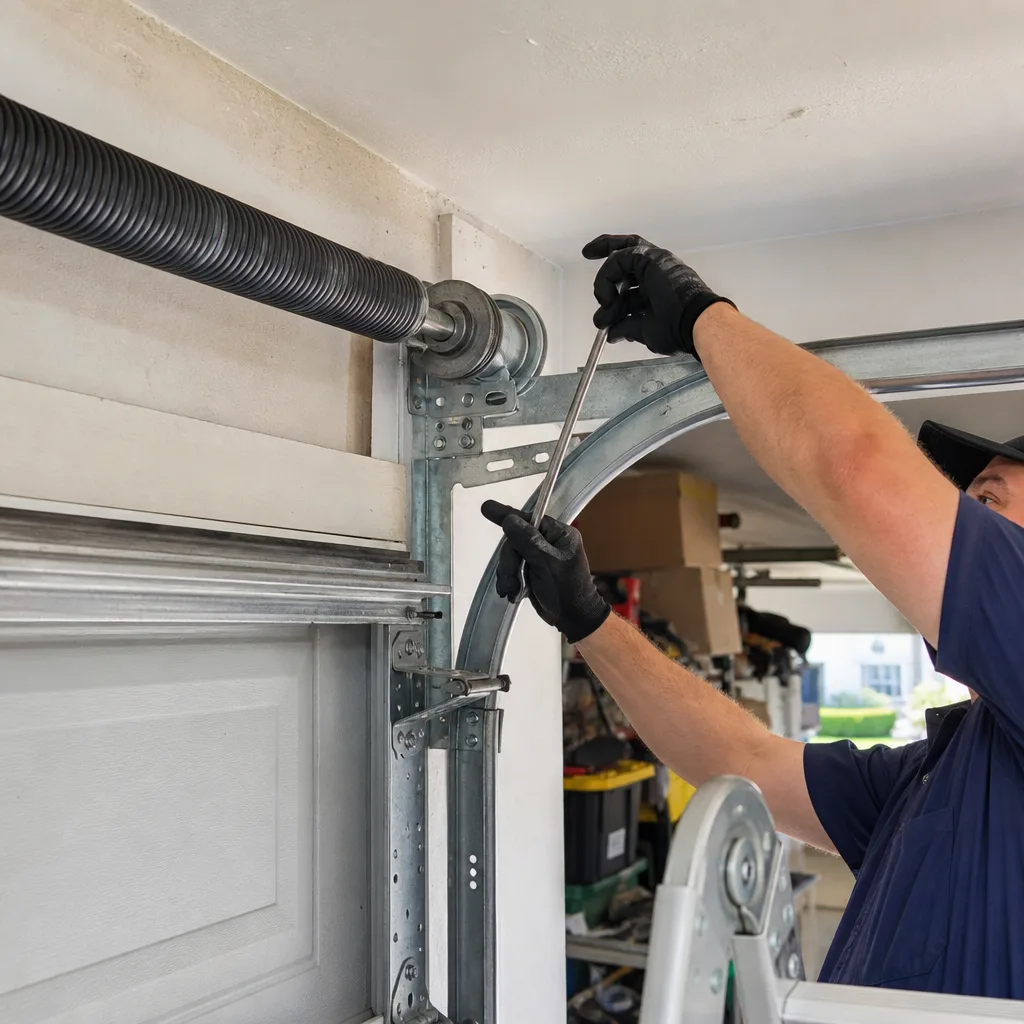 After
After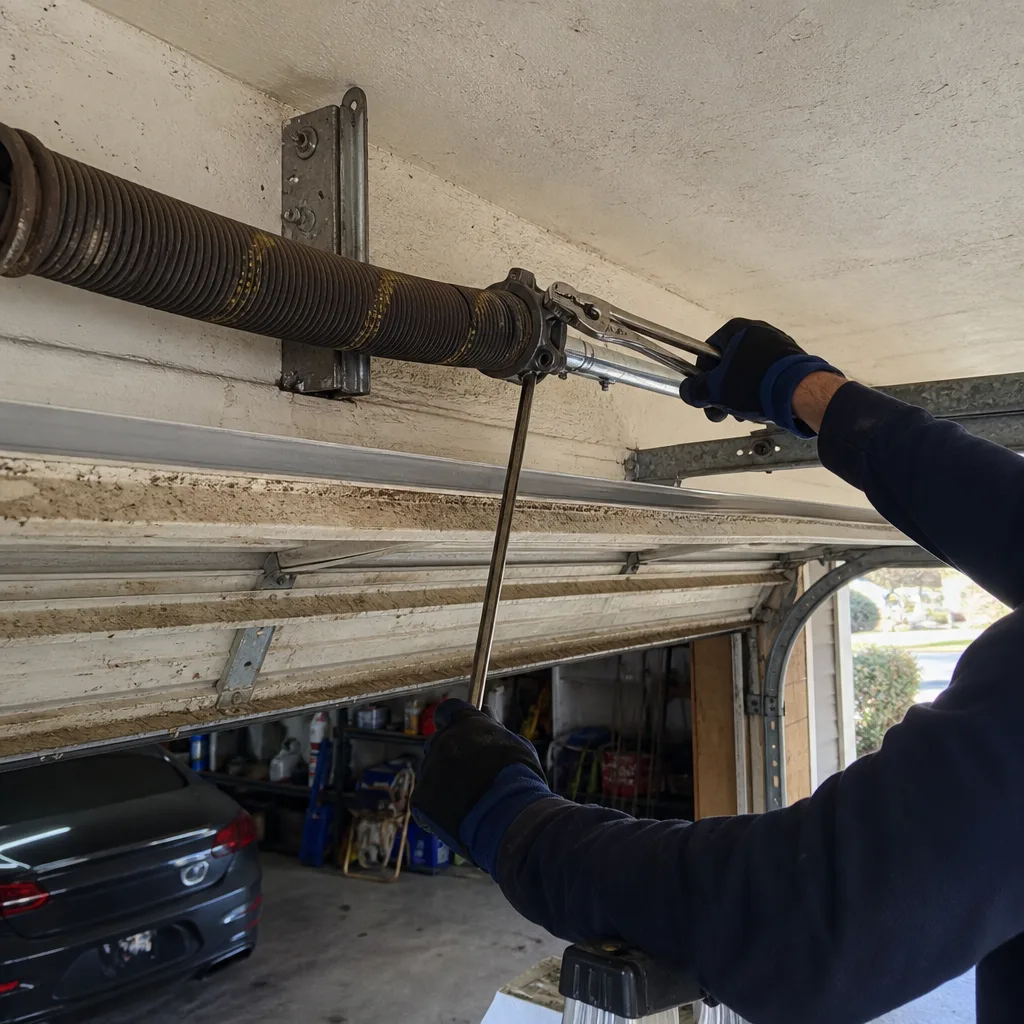 Before
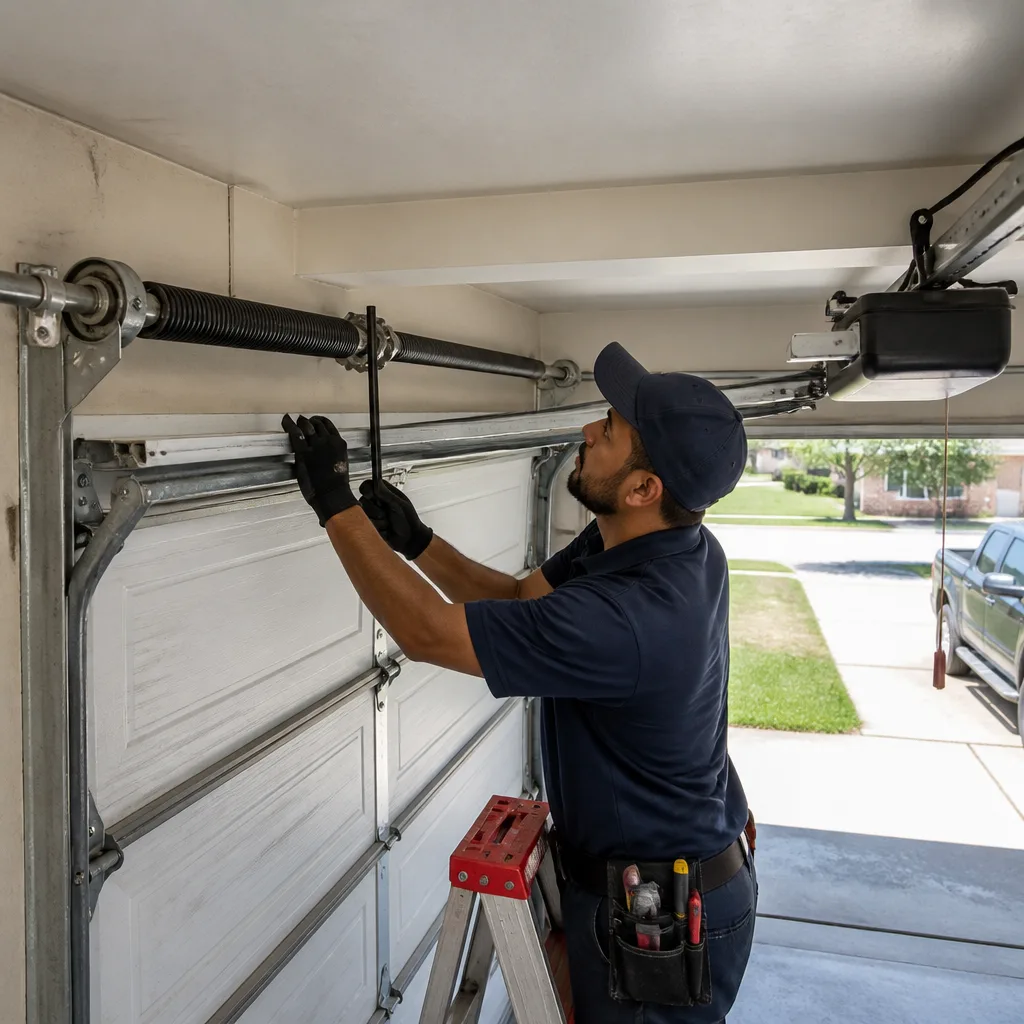 After
AfterSeasonal Garage Door Care for Grand Prairie: Year-Round Homeowner’s Guide
Grand Prairie’s most damaging garage door season is not winter. It is the six-week stretch from mid-September through October, when daytime highs still climb past 90°F but nights drop into the 60s. That temperature swing contracts metal components that spent all summer expanding, and the thermal shock cracks torsion springs, loosens cable drums, and throws opener limits out of calibration. In our 42 years serving this market, we’ve seen more emergency calls during that window than in January and February combined.
This guide maps garage door maintenance to Grand Prairie’s actual weather patterns: two punishing heat cycles, a narrow ice-storm window, and hail season. For a deeper dive, see The Complete Guide to Garage Door in Grand Prairie. You’ll get a month-by-month calendar, the specific warning signs that precede spring failure, and a post-hail inspection protocol most homeowners miss.
Quick Answer
Grand Prairie homeowners should perform garage door maintenance four times per year aligned to local weather stress points: late March after pollen season, mid-June before peak summer heat, mid-September before thermal contraction season, and late January ahead of the ice-storm window. Each check takes 15-20 minutes and covers lubrication, balance, weatherstripping, and opener safety systems. Professional tune-ups catch what visual inspection cannot, particularly torsion spring fatigue and opener force calibration.
Table of Contents
- Why Grand Prairie’s Weather Is Harder on Garage Doors Than Most Guides Admit
- Month-by-Month Maintenance Calendar for Grand Prairie
- What Thermal Cycling Does to Your Torsion Springs
- Surviving the Two Heat Cycles: June-August and the September Surprise
- Preparing for Grand Prairie’s Ice-Storm Window
- Post-Hail Inspection Protocol
- Opener and Photo-Eye Care After Pollen Season
- The 15-Minute Homeowner Inspection Checklist
- Common Mistakes to Avoid
- When to Call a Professional
- Frequently Asked Questions
- The Bottom Line
Why Grand Prairie’s Weather Is Harder on Garage Doors Than Most Guides Admit
Generic seasonal maintenance guides divide the year into four neat quarters. That model fails in North Texas. Grand Prairie sits at the intersection of two climate zones with features that stress garage door systems in ways a Minneapolis or Phoenix guide cannot address.
Our summers bring 50+ days above 100°F. Metal expands. Grease thins and migrates. Vinyl weatherstripping softens and takes a set. Then September arrives with those sharp diurnal swings, and everything that expanded must contract under load. The torsion spring above your door is a hardened steel coil under constant tension. When it cools rapidly after months of heat expansion, micro-cracks propagate. We’ve replaced springs in the Garage Door Repair in Grand Prairie market that showed no visible rust but failed catastrophically from thermal fatigue alone.
Winter brings a different threat. Grand Prairie’s ice-storm window, typically mid-January through mid-February, deposits freezing rain that seals doors to their thresholds. Homeowners pry or force, bending bottom sections or stripping opener gears. The city sits on the Blackland Prairie clay belt, which expands and contracts with soil moisture. That foundation movement transfers to door frames, throwing tracks out of plumb over time. Houses in neighborhoods like Lake Parks and Mira Lagos, built during the 1990s and 2000s boom, show this more than older Grand Prairie stock on sandier soils near Mountain Creek Lake.
Hail season, March through May and again in October, dents door panels and knocks photo-eye sensors out of alignment. A single misaligned safety eye can cause an opener to reverse randomly or refuse to close, and the fix is not always obvious to a homeowner without a laser level.
Finally, spring pollen in Grand Prairie is not a cosmetic nuisance for garage doors. Oak and cedar pollen coat photo-eye lenses, and the sticky residue attracts dust through summer. By July, a sensor that read cleanly in February may be operating at the edge of its tolerance.
The maintenance calendar below addresses each of these real local stressors, not theoretical seasons.
Month-by-Month Maintenance Calendar for Grand Prairie
This calendar aligns tasks to Grand Prairie’s actual weather threats, not calendar quarters. Adjust by two weeks in unusually mild or severe years.
March: Post-Pollen Cleanup and Pre-Hail Prep
Oak pollen peaks in late February through mid-March. Once it settles:
- Wipe photo-eye lenses with a soft cloth and mild glass cleaner. Check alignment: the LED indicators on both units should glow steady, not flicker.
- Inspect door panels for winter damage. Look for cracks in wood doors, dents in steel, or delamination in fiberglass.
- Test auto-reverse: place a 2×4 flat on the threshold and close the door. It should reverse on contact within two seconds.
- Lubricate rollers, hinges, and bearings with a silicone-based product. Avoid WD-40; it attracts dust and gums up in heat.
June: Pre-Peak Summer Tune-Up
Before the sustained 100°F days arrive:
- Check spring tension by disconnecting the opener and lifting the door manually. It should stay at waist height without drifting. If it falls or rises, spring balance is off.
- Inspect weatherstripping for heat softening. Grand Prairie sun can melt vinyl to the threshold.
- Verify opener force settings. Heat-expanded metal increases resistance; an opener set too aggressively in spring can damage components in July.
September: The Critical Thermal Contraction Window
This is the highest-priority check of the year:
- Listen for new noises: popping, creaking, or a sharp “ping” when the door opens. These indicate spring fatigue from contraction stress.
- Check cable drums for looseness. Thermal contraction can cause cables to unwrap slightly.
- Inspect all fasteners. Metal contraction loosens bolts that expanded tight all summer.
- Schedule professional calibration if the door shows any hesitation or uneven movement.
January: Ice-Storm Preparation
- Verify bottom seal flexibility. A hardened seal in cold weather tears when frozen to the threshold.
- Clear drains and slopes so meltwater flows away from the door, not under it.
- Test manual release on the opener. If ice jams the door, you’ll need to disengage without power.
- Apply thin film of silicone spray to the threshold to reduce freeze adhesion.
What Thermal Cycling Does to Your Torsion Springs
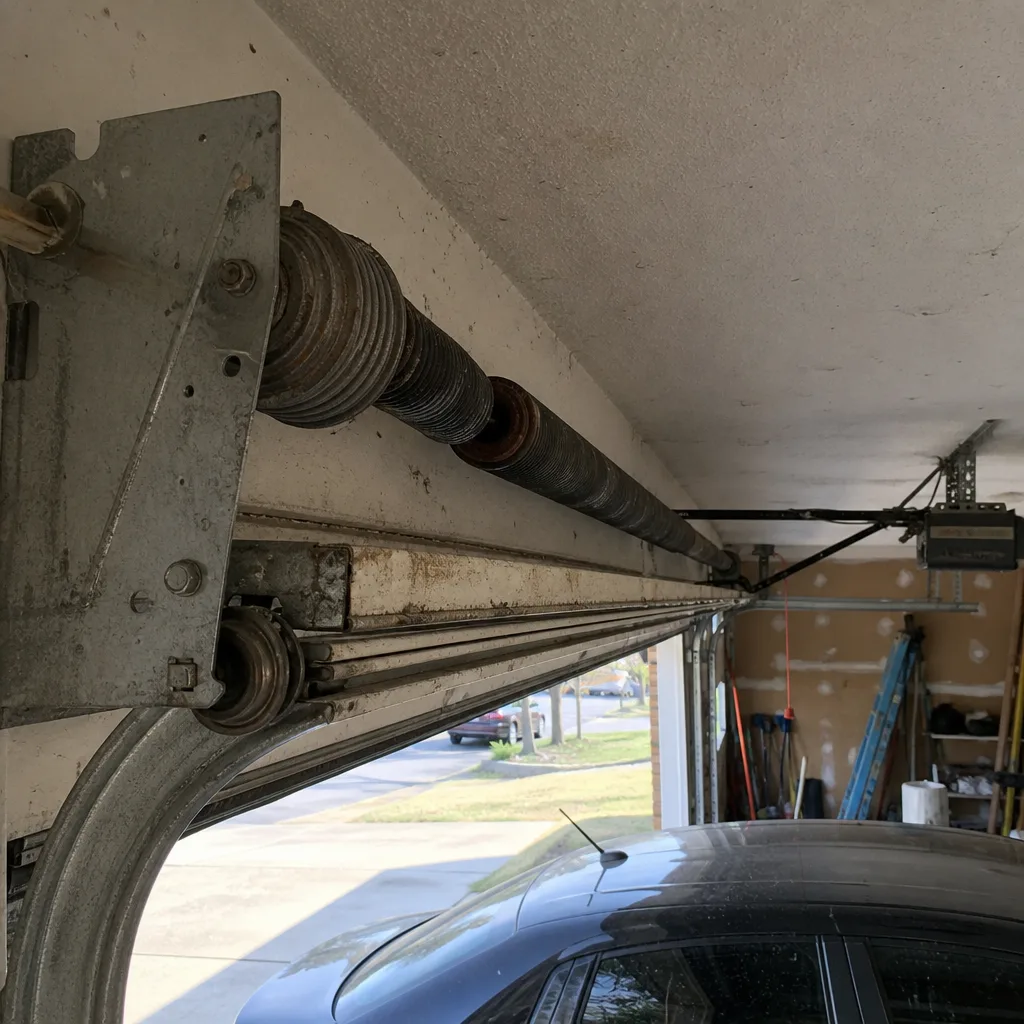
Torsion springs are the most dangerous and most neglected component in any garage door system. They carry the full weight of the door, typically 150-250 pounds for a standard double-car door. In Grand Prairie, they endure a unique torture.
A torsion spring is cold-wound from hardened steel wire. The manufacturing process creates internal stress patterns that are stable at moderate temperatures. But Grand Prairie’s summer heat pushes spring wire past 140°F in an uninsulated garage. The metal expands, coils separate slightly, and the spring operates at a lower effective tension. The opener works harder. The door feels heavier on manual lift.
Then September nights drop to 65°F. The spring contracts rapidly. The wire surface, already work-hardened from thousands of cycles, develops stress risers at microscopic surface flaws. Each heat cycle propagates these cracks deeper. We’ve examined failed springs from Grand Prairie homes that showed no external corrosion, no visible damage, but fractured cleanly across the wire section from thermal fatigue.
The warning signs appear before failure:
- A single loud “pop” or “ping” during operation, especially the first cycle of the morning when the spring is coolest
- The door feels heavier to lift manually, or drifts down from the half-open position
- Visible gap between coils when the door is closed and the spring is at rest (there should be none)
- Rust streaks or powdery residue at the spring ends, indicating fretting from micro-movement
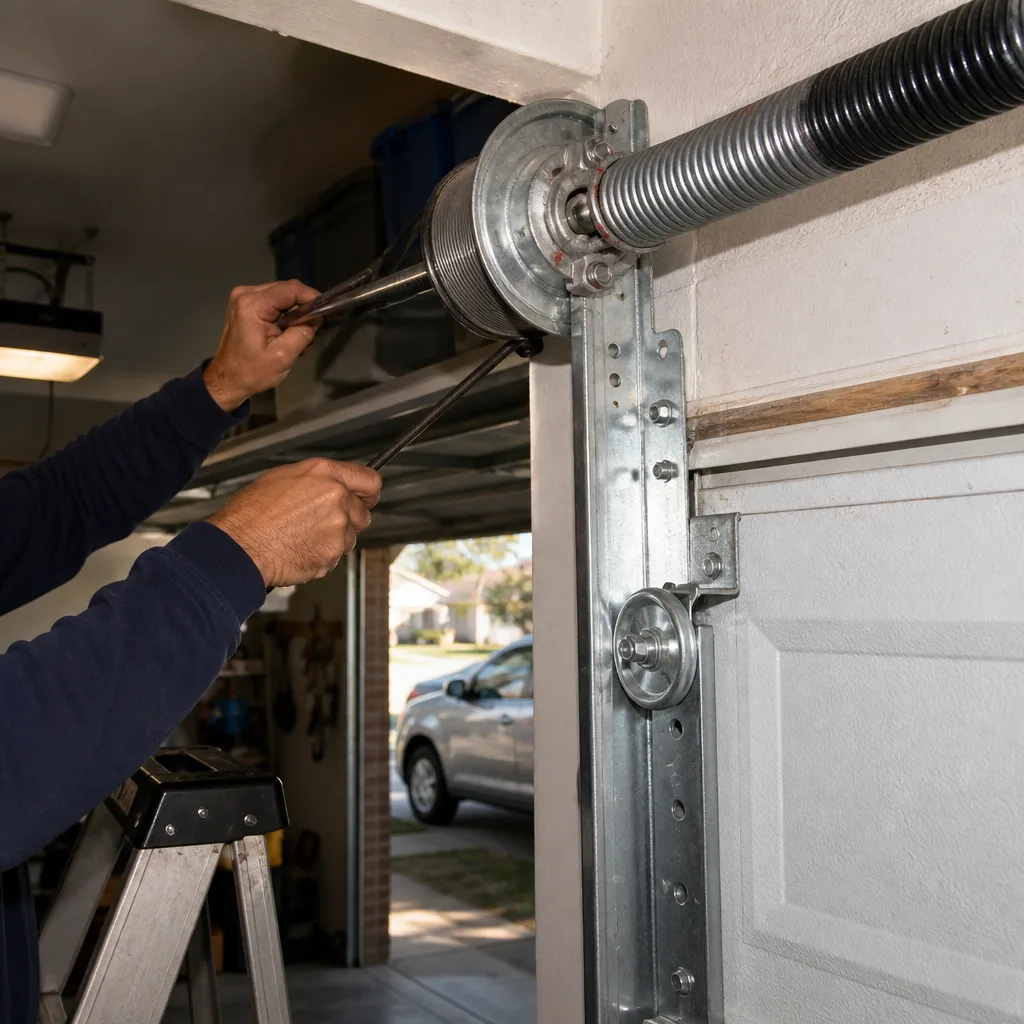
Spring replacement is not a homeowner task. The stored energy in a wound torsion spring can cause serious injury or death if released improperly. Our technicians carry calibrated winding bars and torque-measuring tools. The Mainspring Garage Door Co. home page details our safety protocols.
In Grand Prairie’s climate, we recommend professional spring inspection every September and March. A spring showing thermal fatigue can often be replaced on schedule rather than failing at 6:00 AM on a workday.
Surviving the Two Heat Cycles: June-August and the September Surprise
Grand Prairie experiences two distinct heat stress periods. The first is obvious: sustained triple-digit temperatures from late June through August. The second, the September thermal shock, we’ve already covered. Here’s how to protect your system through both.
First heat cycle (June-August):
Garage temperatures in uninsulated Grand Prairie garages regularly reach 120°F. At that temperature, standard lithium-based garage door grease liquefies and runs off tracks onto your car. We see this every July: doors that ran quiet in May squeal and grind by August because the lubricant has migrated to the bottom of the rail.
Use a high-temperature synthetic lubricant rated for 300°F+ on metal-to-metal contact points. Apply sparingly; excess attracts dust that forms an abrasive paste. For nylon rollers, light oil only on the shaft, never the wheel itself.
Steel doors expand in the heat. A properly fitted door in March may bind in its tracks by July. Check the gap between door edge and track: it should be 1/4 to 1/2 inch consistently. If the door rubs, the track may need adjustment, or the door may be over-insulated with aftermarket kits that swell in heat.
Opener electronics suffer too. Circuit boards in overhead units operate at reduced lifespan above 140°F ambient. If your garage faces west and receives afternoon sun, consider a ventilation fan or reflective barrier on the door exterior. LiftMaster and Chamberlain openers include thermal cutouts that shut the unit down when overheated; if your opener stops mid-cycle on the hottest days, this is likely why, not a motor failure.
Second heat cycle (September):
The September surprise is not heat itself but the rate of change. A spring that expanded gradually over three months contracts 20-30 degrees in six hours. The stress is concentrated at surface flaws. This is when preventive replacement of aging springs pays off most.
Check your door’s balance weekly through September. Disconnect the opener, raise the door to mid-height, and release. It should remain stationary. Any drift indicates spring tension change. Call for service before the spring fails completely.
Preparing for Grand Prairie’s Ice-Storm Window
Grand Prairie’s ice events are infrequent but severe. The typical window runs mid-January to mid-February, when Gulf moisture overrides shallow arctic air at the surface. Ice accumulations of 1/4 to 1/2 inch are common; the 2021 event deposited over an inch.
The immediate threat is threshold freezing. When meltwater refreezes at the door base, the rubber seal bonds to the concrete. A homeowner forcing the door or hitting the opener button strips the seal, bends the bottom section, or strips opener gears.
Prevention is straightforward:
- Inspect the bottom seal in December. It should be pliable, not cracked or hardened. A rigid seal tears rather than releasing from ice.
- Ensure positive drainage away from the threshold. Grand Prairie’s clay soils pool water; a shallow slope or channel prevents accumulation.
- Apply silicone spray to the threshold before forecast ice events. A thin film reduces adhesion.
- If freezing rain is falling, cycle the door every few hours while temperatures are near 32°F. Movement prevents complete bonding.
If the door is frozen shut, do not force it. Use a hair dryer or heat gun on low, working from the center outward. Never use an open flame; the seal is combustible and the door finish will scorch.
After ice events, inspect the weatherstripping along the door sides and top. Grand Prairie’s wind during ice storms drives water into gaps that don’t exist in normal rain. Replace any stripping that has pulled loose or compressed permanently.
The Garage Door Installation in Grand Prairie page includes options for thermally broken doors and improved weatherseal systems for homeowners replacing aged units.
Post-Hail Inspection Protocol
Grand Prairie sits in the southern extent of Tornado Alley. Hail events peak March-May and return in October. A 1-inch hailstone impacts at roughly 50 mph; 2-inch stones exceed 70 mph. Here’s what to check after any event, and what requires professional assessment.
Homeowner inspection (safe, ground-level):
- Panel damage: Dimples in steel, cracks in fiberglass or wood, chipped paint that exposes bare metal to rust. Document with photos for insurance.
- Window inserts: Cracked or shattered acrylic or glass. Even hairline cracks propagate with thermal cycling.
- Photo-eye alignment: Hail impact to the door can jar sensors out of parallel. The receiver LED should glow steady; flickering indicates misalignment.
- Track mounting: Check bracket bolts where track meets wall or ceiling. Hail-driven door vibration can loosen fasteners.
Professional assessment required:
- Spring and cable integrity. Hail impact while the door is moving can shock-load the spring. A technician tests torque and inspects for wire damage not visible to homeowners.
- Opener rail alignment. The rail must be perfectly level; hail-driven door movement can shift mounting points fractions of an inch that cause premature wear.
- Force and limit calibration. After panel damage or component stress, the opener’s safety settings may no longer match actual door resistance. This requires a force gauge and manufacturer procedure.
We carry replacement panels for Clopay, Amarr, and Wayne Dalton doors on our trucks. If hail damage is localized, panel replacement is often more economical than full door replacement, and preserves matching sections for color consistency. See our Garage Door Cost Breakdown: The Grand Prairie Homeowner’s Reference for 2026 for typical pricing.
Opener and Photo-Eye Care After Pollen Season
Grand Prairie’s spring pollen counts regularly exceed 5,000 grains per cubic meter, among the highest in Texas. Oak pollen is particularly problematic: it is sticky, mildly acidic, and electrostatically attracted to the plastic lenses of photo-eye safety sensors.
Photo-eyes are the infrared beam pair mounted 4-6 inches above the floor on each side of the door. They prevent closure if the beam is interrupted. Pollen coating diffuses the beam, reducing effective range. By June, a sensor that read 30 feet in February may read only 15 feet. The door still operates, but safety margin is eroded. A child or pet interrupting the beam at the edge of range may not trigger reversal.
Cleaning is simple but specific:
- Power down the opener at the outlet. This prevents accidental activation.
- Wipe lenses with soft cloth and glass cleaner. Do not use ammonia-based products on plastic lenses; they craze the surface over time.
- Check alignment: both units should face each other squarely. A laser level or even a string line helps. The LEDs should match: both solid, or both off (depending on brand). Mixed states indicate misalignment.
- Test with the 2×4 auto-reverse check described in the March section.
Genie and Chamberlain openers use different indicator patterns; consult your manual or call us for clarification. After cleaning, test the door’s response to actual obstruction, not just the self-test button.
Opener chain or belt tension also changes seasonally. Heat expands metal components; the chain that was correctly tensioned in March may be loose by August. A sagging chain jumps sprocket teeth and damages the opener. Check deflection: mid-span sag should be 1/2 to 3/4 inch for chain drives. Adjust per manufacturer procedure, or schedule our $89 Seasonal Tune-Up.
The Garage Door Opener in Grand Prairie page covers replacement options when repair is no longer economical.
The 15-Minute Homeowner Inspection Checklist
This checklist covers what a careful homeowner can safely assess. It does not replace professional service for spring, cable, or opener force work.
| Component | What to Check | Pass/Fail |
|---|---|---|
| Spring | Visible coils intact, no gaps at rest, no rust streaks | Visual only |
| Cables | No fraying, no unwinding from drum, equal tension both sides | Visual/touch |
| Rollers | Roll smoothly in track, no wobble, no cracked wheels | Operational |
| Tracks | Vertical plumb, horizontal level, bolted securely | Visual |
| Weatherstripping | Pliable, intact, seals against door and threshold | Visual/touch |
| Photo-eyes | Lenses clean, LEDs steady, beam unobstructed | Operational |
| Auto-reverse | Door reverses on 2×4 contact within 2 seconds | Test |
| Manual release | Handle moves freely, door operable by hand | Test |
| Door balance | Stays at mid-height when opener disconnected | Test |
| Noise | No grinding, popping, or squealing during cycle | Operational |
Perform this check in March, June, September, and January. Record results; trending changes over time predict failures before they strand you.
Common Mistakes to Avoid
- Using WD-40 as garage door lubricant. It is a solvent, not a lubricant. It dissolves existing grease, attracts dust, and gums up in Grand Prairie heat. Use silicone-based or lithium-based products rated for high temperature.
- Ignoring September noises. That new creak or pop is not “the house settling.” It is a torsion spring announcing thermal fatigue. Waiting for complete failure costs more and risks vehicle entrapment.
- Forcing a frozen door. In Grand Prairie’s ice events, the threshold bond can exceed 200 pounds of adhesion. Force strips seals, bends bottom sections, and strips opener gears. Thaw gently or call for service.
- Cleaning photo-eyes with ammonia products. Windex and similar products craze acrylic lenses over time, diffusing the safety beam. Use mild glass cleaner or water with a drop of dish soap.
- Adding insulation to an already heavy door without spring adjustment. Grand Prairie homeowners sometimes add reflective insulation kits for summer heat. A 16×7 steel door that weighed 180 pounds now weighs 220. The original spring is undersized. The opener strains. Failure follows.
- Skipping post-hail professional inspection. Panel dents are obvious. Spring shock damage is not. A spring compromised by hail impact may fail weeks later, apparently without cause.
- Assuming all brands use the same photo-eye indicator logic. LiftMaster steady green means aligned; some Genie models flash when correct. Misreading indicators leads to false confidence or unnecessary service calls.
When to Call a Professional
Call a trained technician for any work involving torsion springs, cable tension, or opener force calibration. These components store lethal energy and require specialized tools. In Grand Prairie’s climate, we also recommend professional service when you detect new noises after temperature swings, after any hail event regardless of visible damage, and for annual calibration of safety systems.
Mainspring Garage Door Co. offers free estimates in Grand Prairie. Our trucks carry springs, cables, rollers, and opener components for all major brands, so most jobs finish in a single visit. The price is stated before work begins, with no surprises on the bill. Call (972) 645-4416 to schedule, or to discuss whether your door’s age and condition warrant repair or replacement.
Frequently Asked Questions
Four times per year, aligned to the maintenance calendar in this guide: March, June, September, and January. The September application is most critical, as proper lubrication reduces friction during thermal contraction. Use synthetic lubricant rated for 300°F+, not WD-40. Call (972) 645-4416 if you’re unsure which product suits your door type.
No. Torsion springs store enough energy to cause serious injury or death if improperly released. The winding and unwinding process requires calibrated bars, torque measurement, and training. In Grand Prairie, we’ve seen homeowners attempt this after watching online videos; the emergency room visits that follow are preventable. Our technicians carry the proper tools and background-check credentials for safe spring service.
Thermal expansion of the door or track, or thinning of lubricant in heat. In Grand Prairie’s summer, uninsulated garages reach 120°F by mid-afternoon. Metal components expand; grease migrates. Check track alignment gaps and upgrade to high-temperature lubricant. If the door binds consistently above certain temperatures, the track may need adjustment for summer clearance.
Mainspring Garage Door Co. offers a $89 Seasonal Tune-Up that includes spring torque check, lubrication, hardware tightening, photo-eye cleaning and alignment, auto-reverse test, and opener force calibration. The price is confirmed before we start. Seniors and veterans receive an additional 5% discount. Call (972) 645-4416 to schedule.
Only if the door is already compromised. A healthy steel or fiberglass door with intact finish withstands most Grand Prairie hail. Replace if you have existing panel damage that reduces structural integrity, or if the door is over 20 years old with thinning metal. For newer doors, proper maintenance and post-event inspection are sufficient. We offer free second opinions on replacement quotes from other companies.
No. At Mainspring Garage Door Co., the flat price is stated before any work begins. If we discover additional issues during service, we stop and explain before proceeding. You approve every charge. There are no surprises on the bill, and our 90-Day Done Right Promise covers the work in writing. This is how we’ve operated since 1984.
The Bottom Line
Grand Prairie’s garage doors face a maintenance calendar built around real local threats: two heat cycles that expand and contract metal, a September thermal shock window that cracks springs, an ice-storm period that seals doors to thresholds, and hail that dents panels and misaligns safety systems. The homeowners who avoid emergency calls are not luckier; they inspect in March, June, September, and January, and they call at the first warning sign rather than the first failure.
Professional service catches what visual inspection cannot: spring torque fatigue, opener force drift, and track micro-movement from our expansive clay soils. The cost of prevention is modest. The cost of a 6:00 AM emergency, with a car trapped inside and a workday pending, is not.
Written by Carl Dutton, Owner at Mainspring Garage Door Co., serving Grand Prairie since 2016.