
Last updated September 10, 2026
Full 25-point door and opener safety check with every visit - springs, cables, rollers, tracks, and your LiftMaster or Chamberlain opener included
You get a price before we start. It does not change when the truck arrives.
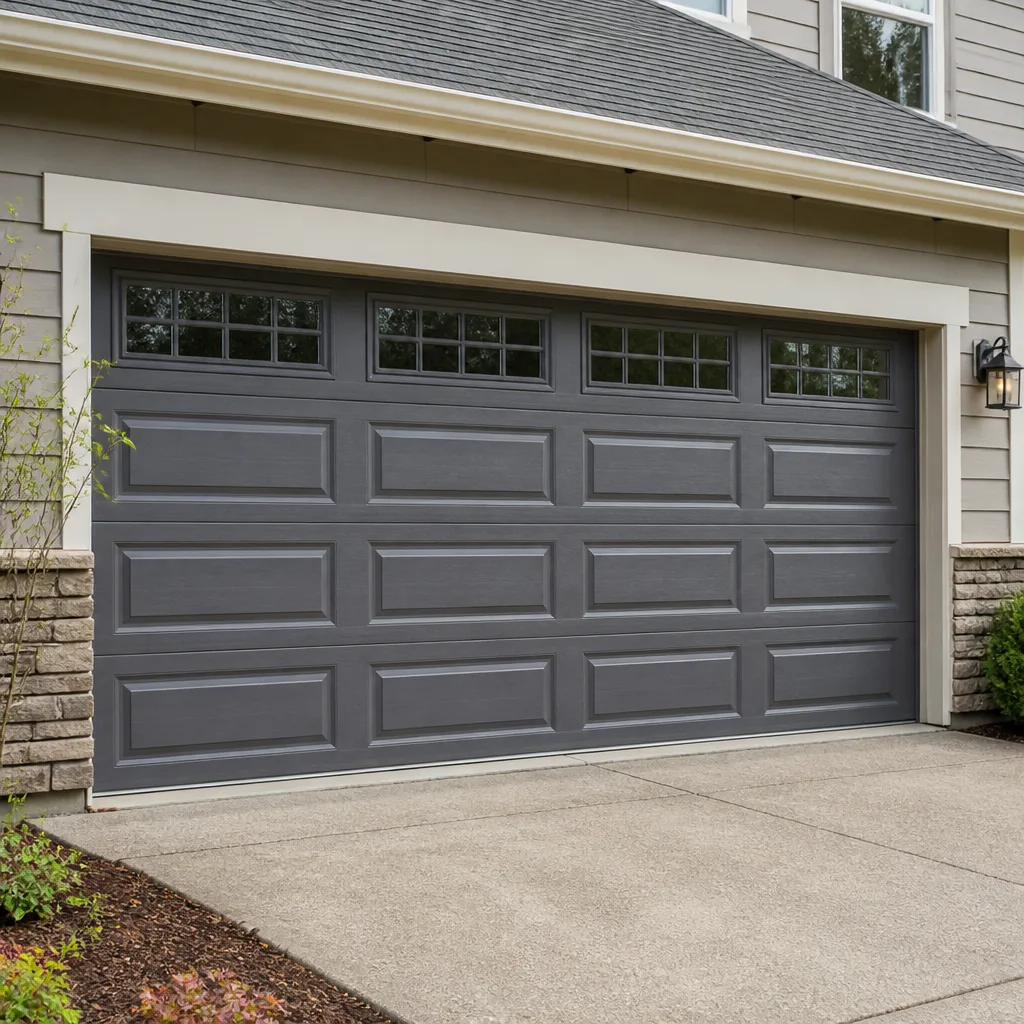
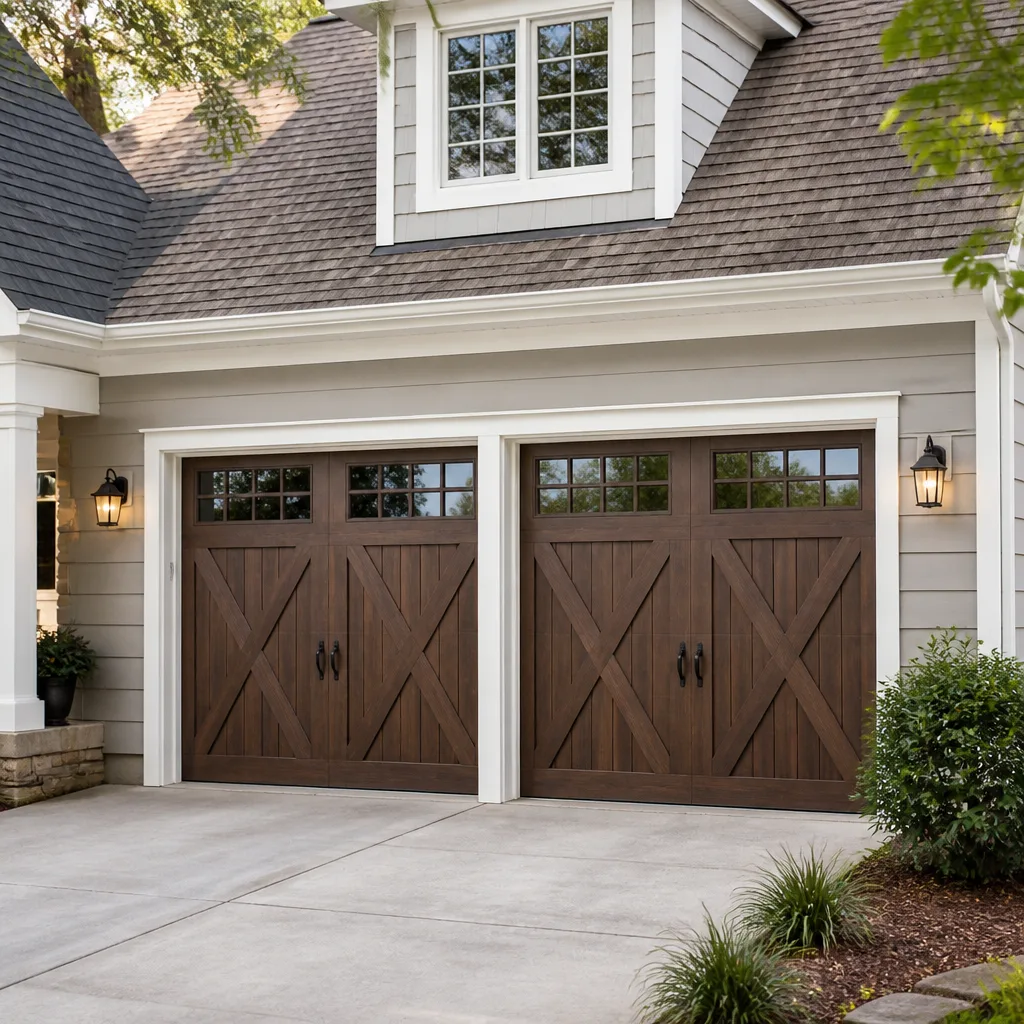
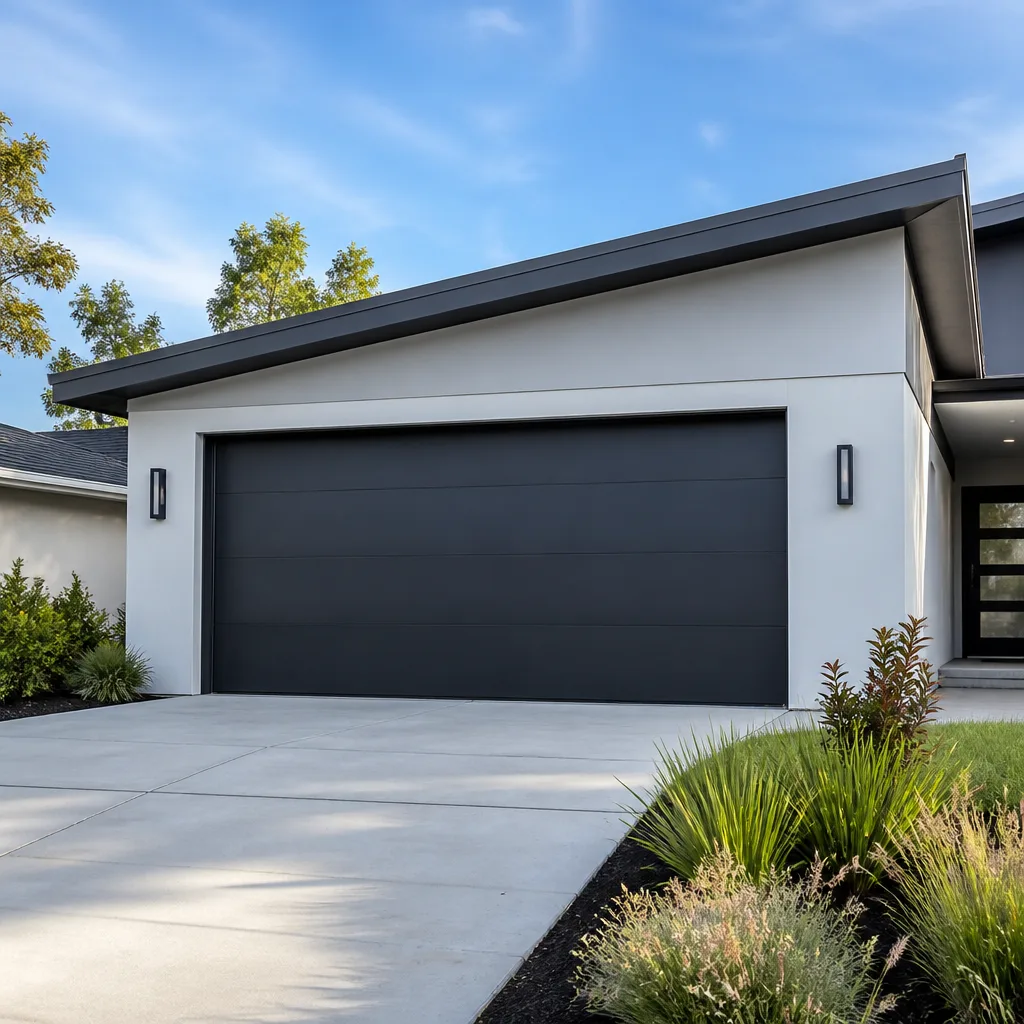
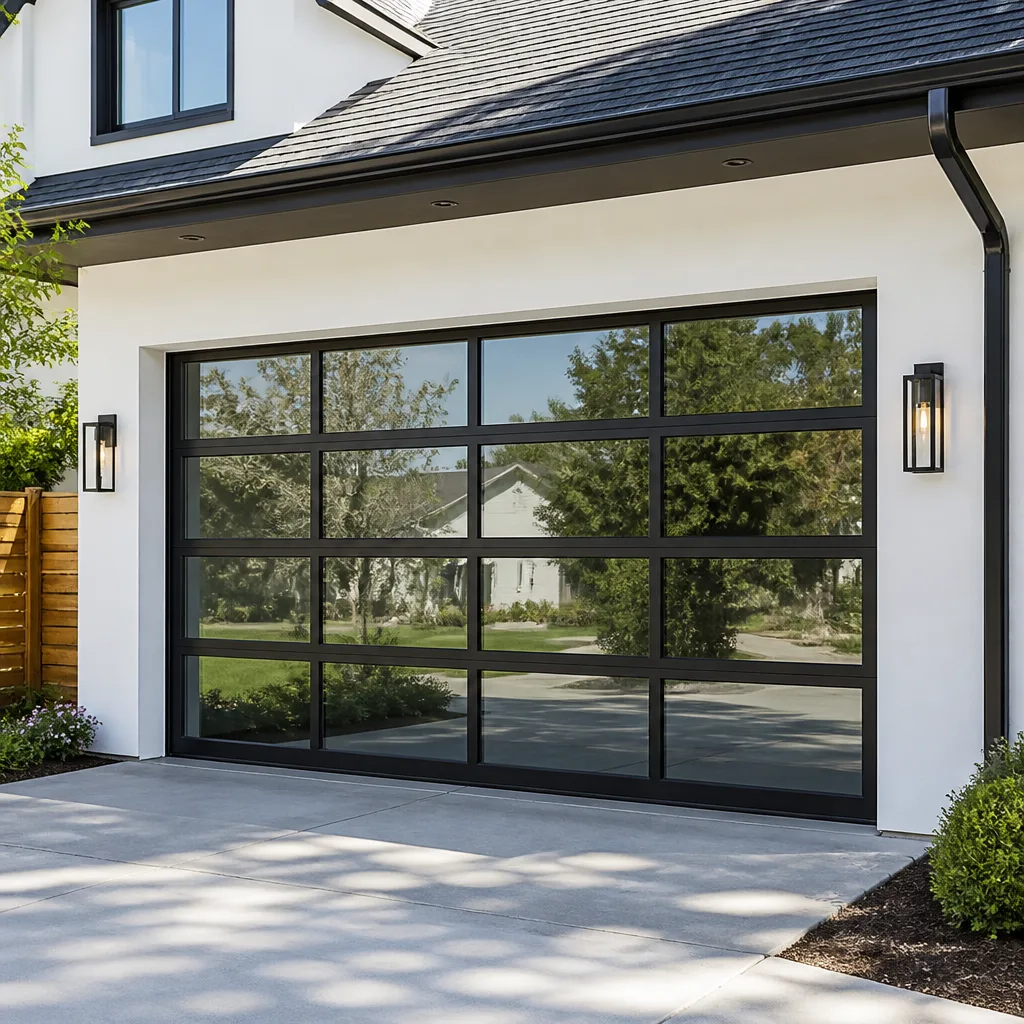
 Before
 After
After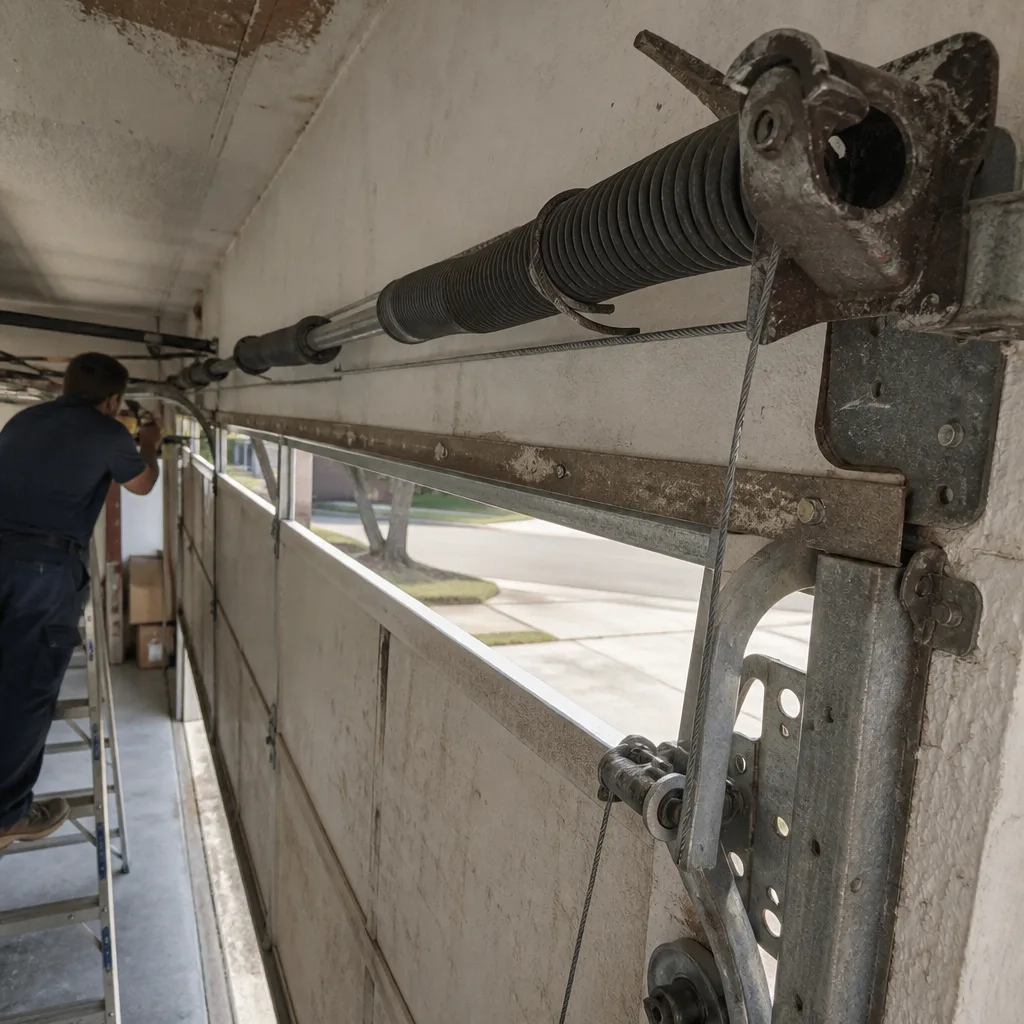 Before
 After
After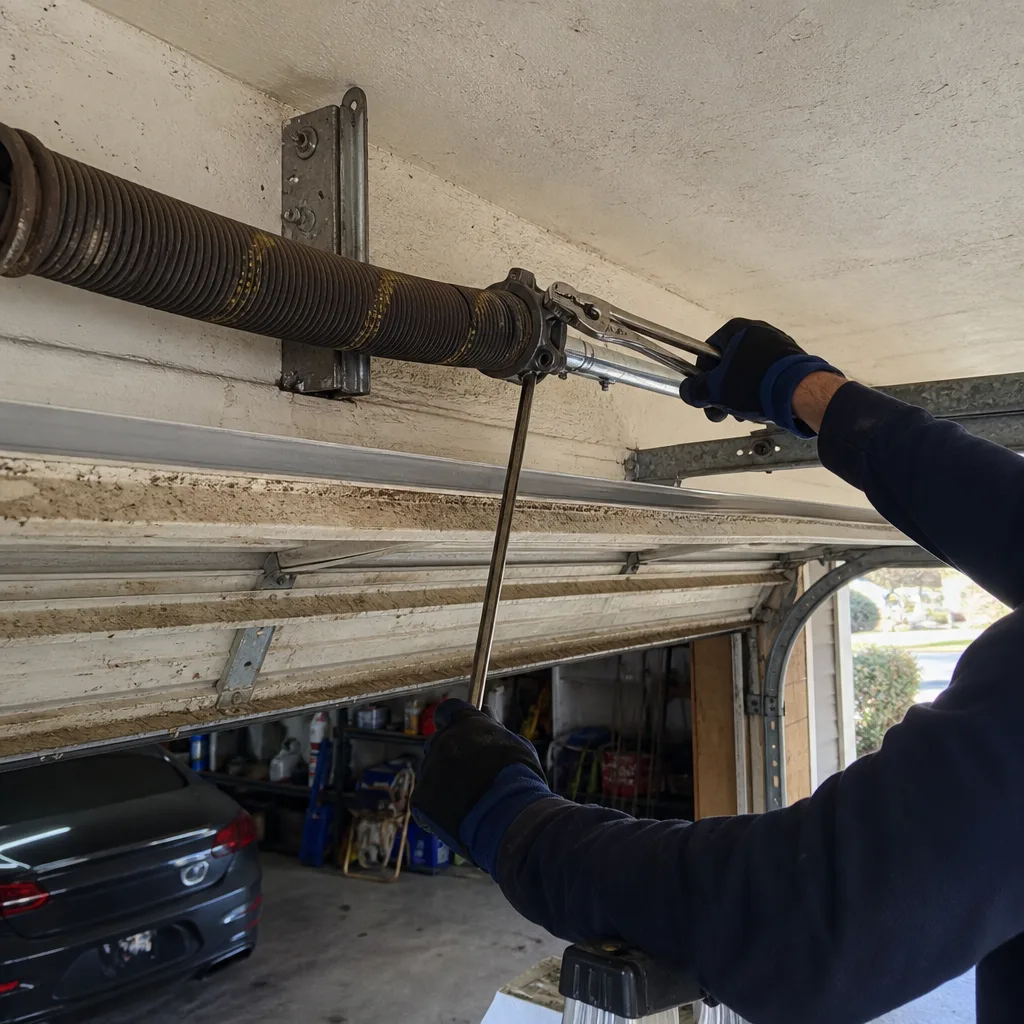 Before
 After
AfterDIY vs Professional Garage Door: The Grand Prairie Homeowner’s Decision Guide
A standard seven-foot residential garage door weighs between 150 and 250 pounds, yet most Grand Prairie homeowners open and close it with a single finger on the remote. That effortless motion depends entirely on torsion springs wound tight enough to store roughly the same kinetic energy as a coiled rattlesnake. When that spring lets go, it does not warn you. In our 42 years of service, we have seen the aftermath of DIY spring projects in neighborhoods from Lake Parks to Dalworth Gardens, and the pattern is always the same: the homeowner was careful, followed a video, and still lost control for one critical second. This guide will show you which garage door jobs are genuinely worth doing yourself, which ones carry mechanical consequences no amount of caution prevents, and how to tell the difference before you pick up a tool. For Garage Door Repair Maintenance Checklist for Grand Prairie Homeowners and related resources, see our blog.
Quick Answer
Most Grand Prairie homeowners can safely handle sensor realignment, remote programming, track cleaning, and weather seal replacement. Torsion spring replacement, cable repair, and door panel replacement should be done by a trained technician. The dividing line is stored mechanical energy: if a failed repair could release a 200-pound door or a wound spring, the job belongs to a professional.
Table of Contents
- Understanding the Real Risks of Garage Door Work
- Task-by-Task: What You Can DIY and What You Shouldn’t
- Why Torsion Springs Are Different From Every Other Home Repair
- DIY-Appropriate Tasks for Grand Prairie Homeowners
- The Hidden Cost of a Failed DIY Attempt
- The Single Question That Decides It
- Tools, Time, and the Reality of First-Time Work
- When to Call a Professional
Understanding the Real Risks of Garage Door Work
Home improvement stores in Grand Prairie stock garage door parts on the same aisle as light fixtures and cabinet hardware. That placement creates a false equivalence. Replacing a light switch and replacing a garage door spring are not comparable tasks, though they sit on shelves three feet apart.
The risk taxonomy for garage door work breaks down into three categories:
- Cosmetic risk: A scratched panel or misaligned seal. You live with it or fix it next weekend. No one gets hurt.
- Functional risk: A door that sticks, reverses unexpectedly, or opens unevenly. Annoying, possibly damaging to the door or opener over time, but not immediately dangerous.
- Kinetic risk: A spring, cable, or door under tension that can move faster than human reflexes can react. This is where serious injury happens.
Most home repairs carry cosmetic or functional risk. Garage door work is one of the few common homeowner projects that crosses into kinetic risk, and it does so in ways that are not obvious until you understand the physics.
A torsion spring on a standard residential door is wound to between 7,000 and 15,000 inch-pounds of torque. That is not a number most people can visualize. Here is a better frame: if the winding bar slips from your hands during installation, the spring unwinds in roughly one-quarter second. The bar becomes a projectile. We have seen winding bars embed in garage drywall. We have seen them break fingers and worse. The spring itself can whip across the header space with enough force to fracture bone.
This is not about being strong or careful. It is about reaction time versus mechanical speed. No human is fast enough.
Grand Prairie’s climate adds another variable. Our hot summers and occasional ice events mean springs fatigue faster than in milder climates. A spring that looks intact may be closer to failure than its appearance suggests. In the Westchester neighborhood, where many homes were built in the 1980s and 1990s, we regularly find original springs still in service, their cycle life exhausted, waiting for the wrong moment to let go.
Task-by-Task: What You Can DIY and What You Shouldn’t
Here is how common garage door tasks sort by actual risk, tool requirement, and realistic time for a non-specialist. We have rated each on a five-point scale based on what we observe on service calls across Grand Prairie.
| Task | Risk Level | Tools Needed | Time (First Attempt) | DIY Verdict |
|---|---|---|---|---|
| Lubricate rollers, hinges, and tracks | 1/5 | Silicone or lithium grease, rag | 20-30 minutes | Recommended |
| Realign safety sensors | 1/5 | Hands, possibly a rag for cleaning lenses | 10-15 minutes | Recommended |
| Replace remote batteries / program remotes | 1/5 | New battery, ladder for opener access | 10-20 minutes | Recommended |
| Replace bottom weather seal | 2/5 | Replacement seal, utility knife, possibly lubricant to slide track | 30-60 minutes | Recommended with caution |
| Tighten loose track brackets or roller hardware | 2/5 | Socket wrench set, ladder | 20-40 minutes | Recommended with caution |
| Replace damaged roller (not bottom roller) | 3/5 | Socket wrench, locking pliers, ladder | 45-90 minutes | Possible, but often slower than expected |
| Replace extension spring (if equipped) | 4/5 | Winding bars, C-clamps, sockets, safety cables | 2-4 hours | Not recommended |
| Replace torsion spring | 5/5 | Specific winding bars (not substitutes), vice grips, sockets, ladders | 3-5 hours (first time) | Professional only |
| Replace or adjust cables | 5/5 | Same as spring work plus cable pullers | 2-4 hours | Professional only |
| Replace door panel or full door | 4/5 | Multiple ladders, helpers, specialized hardware | 4-8 hours | Professional recommended |
| Replace or relocate opener | 3/5 | Electrical work, ladder, shims, mounting hardware | 3-6 hours | Professional recommended |
The pattern is clear. Tasks that involve stored tension or the full weight of the door cluster at the high-risk end. Tasks that involve adjustment, cleaning, or electronics sit at the low-risk end. The middle ground, tasks like roller replacement, are where homeowners most often underestimate the difficulty. A seized roller in a 20-year-old track in the South Grand Prairie area may require more force to extract than the surrounding hardware can withstand. We have been called to jobs where a well-intentioned roller replacement turned into a bent track and a door off its rails.
Garage Door Repair in Grand Prairie covers the full range of these tasks, from the simple adjustments you might handle yourself to the complex work our technicians manage daily.
Why Torsion Springs Are Different From Every Other Home Repair
Every home repair has its hazards. Electrical work can shock. Roof work involves falls. But torsion spring work has a unique characteristic: the danger is not proportional to the mistake.
In most dangerous tasks, a small error produces a small consequence. Touch the wrong wire, you get a mild shock before you pull back. Miss a nail, you hit your thumb. These are linear risks.
Torsion spring work is non-linear. The spring is either controlled or it is not. There is no partial failure mode that gives you warning. When control is lost, the full stored energy releases instantly, regardless of how small the slip was.
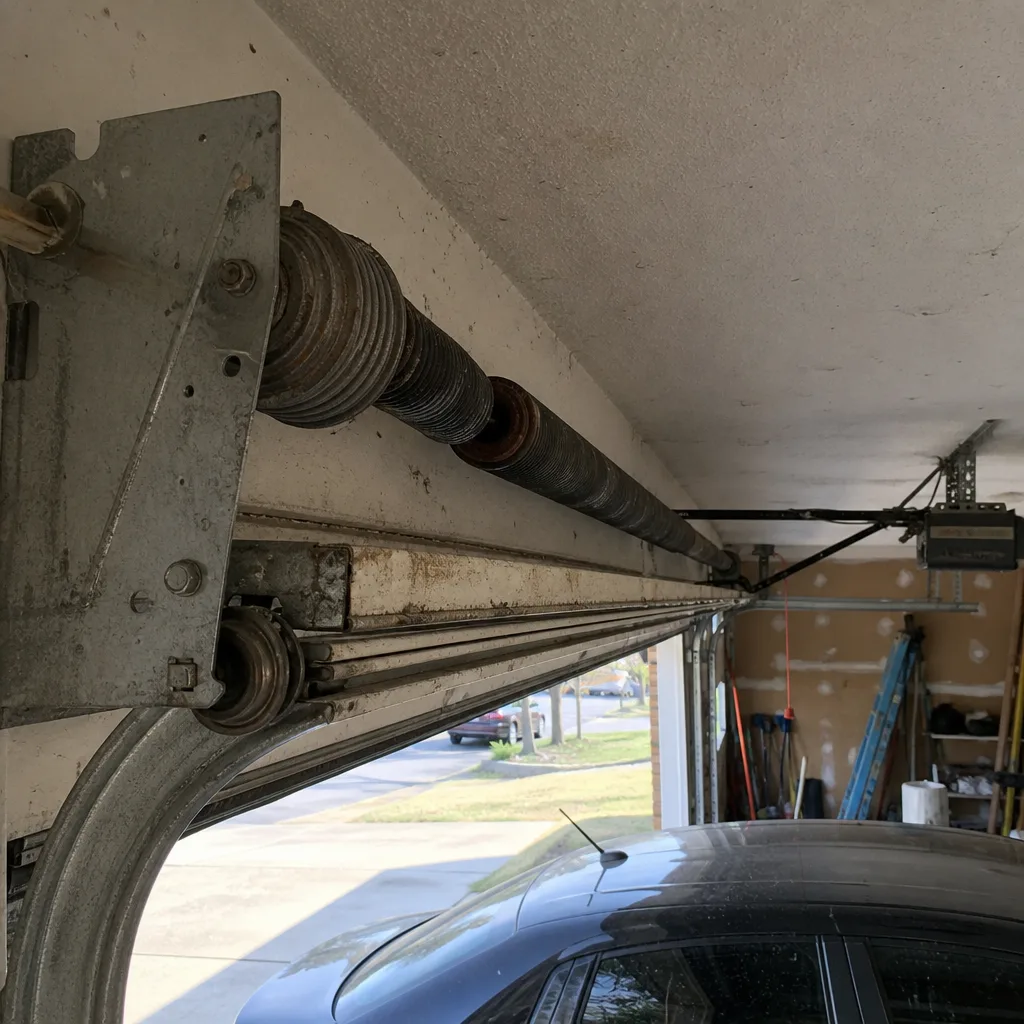
Here is how the system works. A torsion spring is mounted on a steel shaft above the door, anchored at the center bracket and wound tight at the cable drums on each end. The spring is sized to the door’s weight: a 16-foot wide door in a Grand Prairie home with an attached three-car garage might use a pair of .250-inch wire springs, each wound to 30 quarter-turns. Each quarter-turn stores energy. The total stored energy is sufficient to lift the door’s full weight with minimal help from the opener.
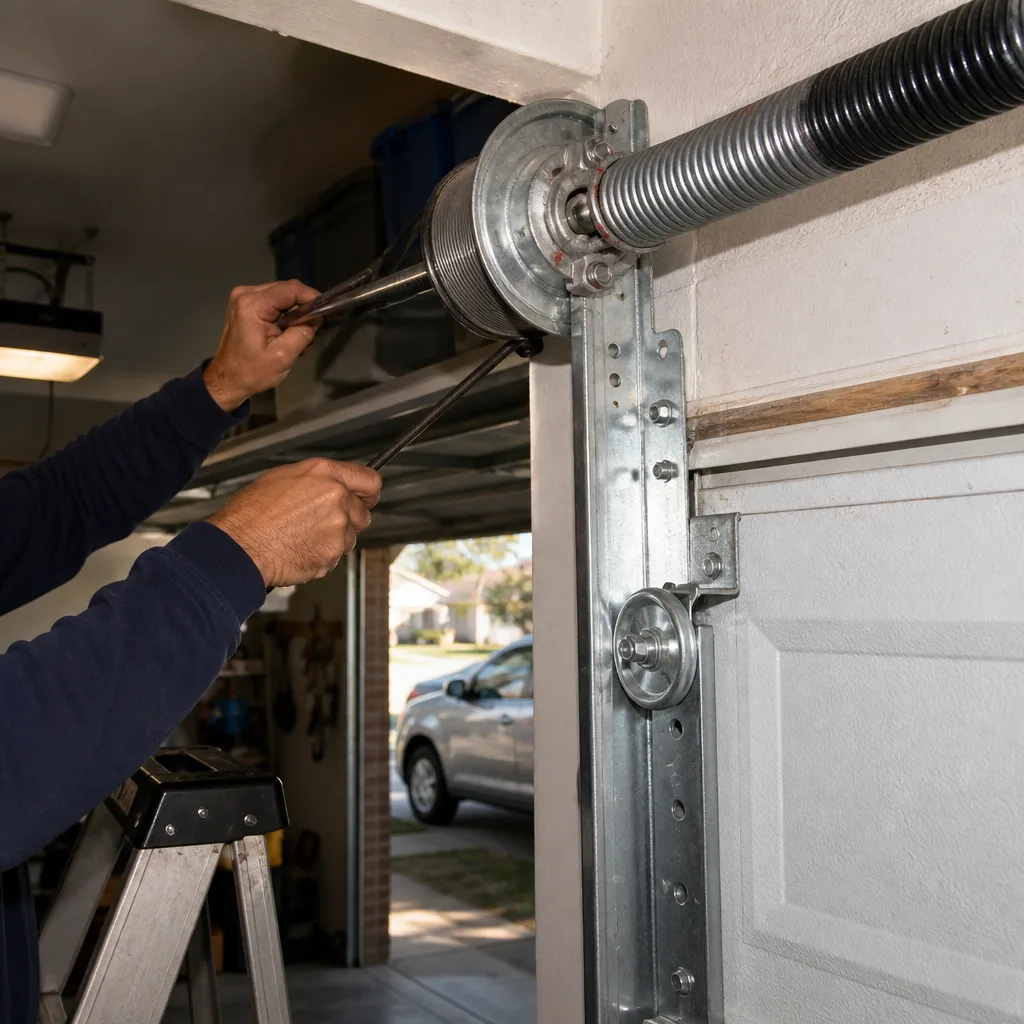
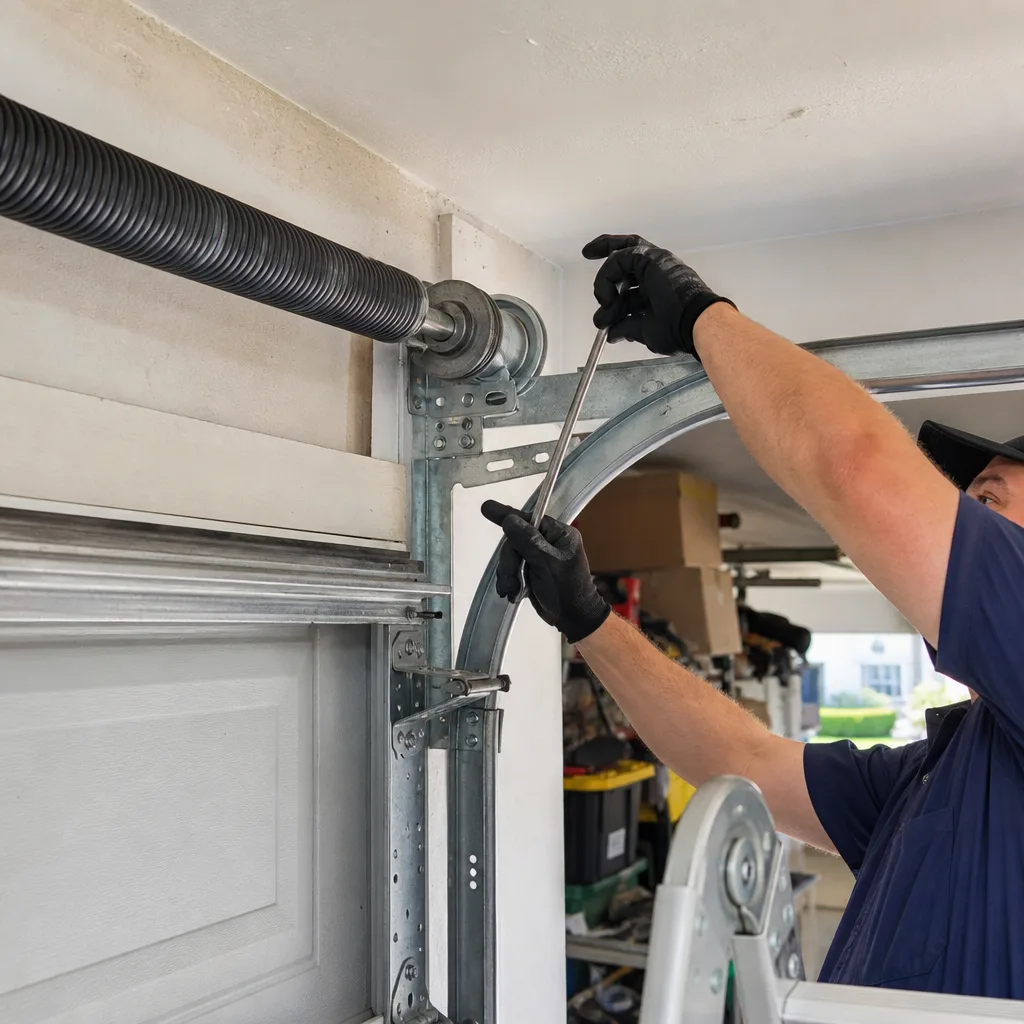
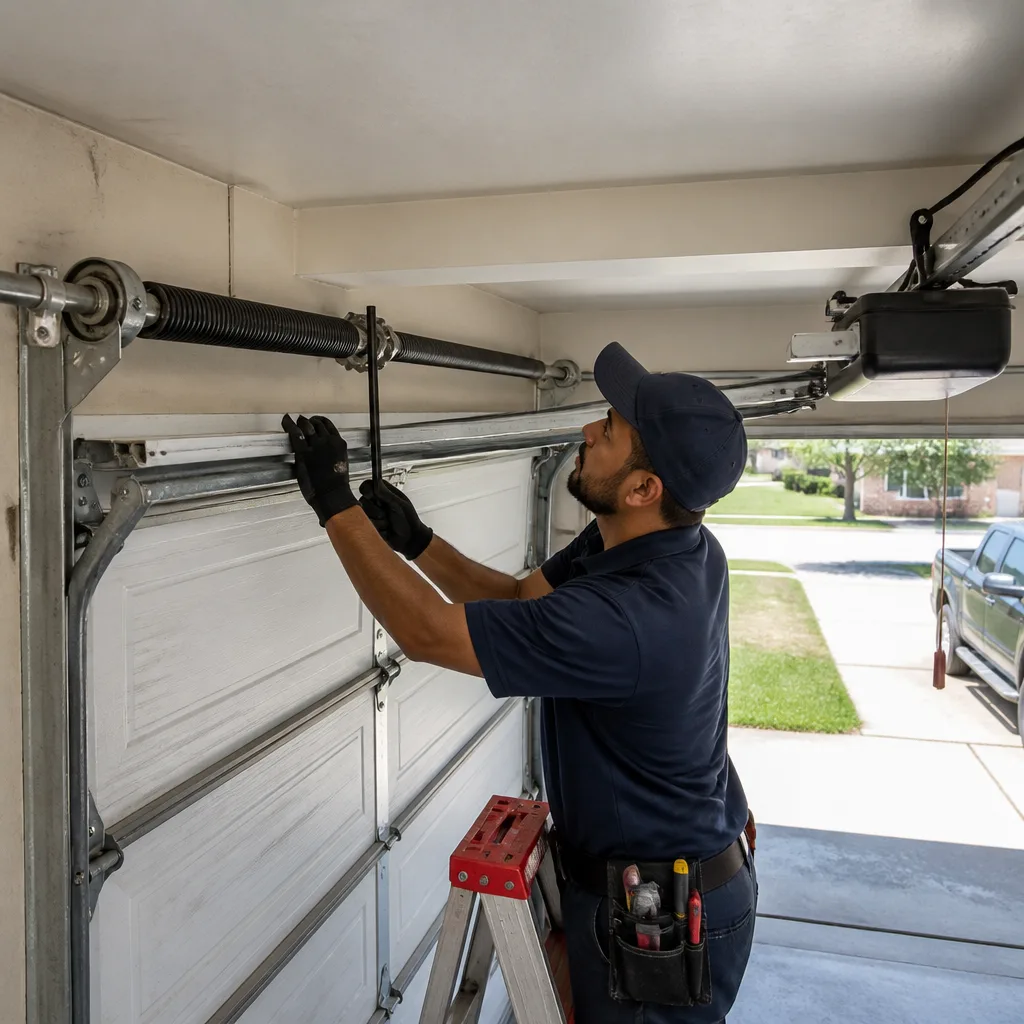
The winding process requires inserting solid steel bars into the cogs of the winding cone and adding or releasing tension in controlled increments. The bars must be the correct diameter and inserted fully. A common and fatal improvisation is using a screwdriver, wrench, or other tool as a substitute. These tools are not designed to withstand the torque. They slip or break, and the spring unwinds.
Even with proper bars, the procedure requires simultaneous actions: holding tension on one bar while removing and reinserting the other, keeping the body clear of the winding cone’s path, and maintaining balance on a ladder. A 65-year-old homeowner in Dalworth Gardens, steady on a ladder for twenty years, is not suddenly clumsy. The task simply demands more than steady hands. It demands that no mistake occur during a procedure where a mistake is irreversible.
We have heard every variation of “I watched the video.” Videos compress a 45-minute procedure into four minutes of highlights. They do not show the dropped bar, the miscounted turn, the spring that was wound backward and must be unwound. They do not show the emergency room visit.
In Grand Prairie, Garage Door Permits, Codes & Inspections in TX: What You Need to Know do not prohibit homeowner spring replacement. That absence of prohibition is not an endorsement. It simply means the city does not inspect garage door maintenance. The mechanical reality is unchanged.
DIY-Appropriate Tasks for Grand Prairie Homeowners
Not every garage door task carries kinetic risk. Several maintenance and minor repair jobs are genuinely appropriate for homeowners, save money, and improve door performance. Here are the ones we encourage.
1. Lubrication (Every 6 Months)
Grand Prairie’s dust and pollen, combined with summer heat that thins lubricant, mean doors need regular attention. Use lithium-based grease or silicone spray on rollers, hinges, and the top of the rail where the trolley runs. Do not use WD-40 as a lubricant; it is a solvent that removes existing grease.
- Close the door and disconnect the opener by pulling the red release cord.
- Wipe the tracks with a dry cloth to remove buildup. Do not lubricate the tracks; the rollers need friction to roll, not slide.
- Apply a small amount of grease to each roller bearing, hinge pivot, and the spring coils themselves.
- Run the door up and down manually to distribute.
- Reconnect the opener.
Time: 20 minutes. Cost: Under $10. Benefit: Extended component life, quieter operation.
2. Safety Sensor Realignment
Photo eyes near the floor on each side of the door must face each other precisely. When they do not, the door reverses immediately or refuses to close. This is the most common cause of “my door won’t close” calls we receive in Lake Parks and other Grand Prairie neighborhoods, and it is usually a 10-minute fix.
- Check that both sensors show a steady light (usually green on one, amber on the other; varies by manufacturer).
- If one is blinking or dark, clean the lens with a soft cloth.
- Loosen the wing nut or screw holding the bracket, adjust until both lights are steady, and retighten.
- Test by closing the door and waving a foot through the beam; it should reverse.
3. Remote and Keypad Programming
Openers from Chamberlain, Genie, and other major brands follow similar patterns. The “learn” button on the motor unit (usually purple, red, or yellow) initiates pairing. Specific steps vary by model year, so consult the manufacturer’s manual rather than generic advice. If you have lost the manual, most are available online by model number.
4. Bottom Weather Seal Replacement
The rubber or vinyl seal on the door’s bottom edge deteriorates in Texas sun. Replacement seals slide into a retainer channel. The challenge is often finding the correct profile: T-shaped, bead-shaped, and bulb-shaped seals are not interchangeable. Bring a piece of your old seal to a hardware store, or call us for the correct match.
Garage Door Installation in Grand Prairie includes complete weather sealing as part of new door setup, but existing doors can be refreshed with this simple maintenance.
The Hidden Cost of a Failed DIY Attempt
The Garage Door Cost Breakdown: The Grand Prairie Homeowner’s Reference for 2026 shows the financial argument for DIY is straightforward: parts cost less than professional service. A pair of torsion springs retails for $40-$80. Our installed price is higher. The gap seems to favor doing it yourself.
But the economics change when the first attempt fails. Here is what we observe on service calls where we are asked to finish or correct a homeowner’s work.
Scenario one: Incorrect spring sizing. The homeowner purchased springs by door weight but missed the cable drum type or track radius. The door opens unevenly or strains the opener. We remove the incorrect springs, source the correct ones, and reinstall. Cost: typically 1.5x the original professional quote because we charge for removal plus standard installation.
Scenario two: Winding error. The spring is the right size but wound to incorrect tension. The door is heavy to lift manually or slams closed. Correcting this requires unwinding and rewinding, essentially doing the job twice. Cost: near the full installation price.
Scenario three: Hardware damage. An improvised tool damages the winding cone, center bracket, or cable drum. These are not always available separately; sometimes the full spring assembly or shaft must be replaced. Cost: exceeds original professional quote significantly.
Scenario four: Injury. We will not detail this, but it is the outcome that makes all cost comparisons irrelevant.
In Grand Prairie’s market, a professional torsion spring replacement from Mainspring Garage Door Co. home includes correct sizing, proper winding, safety cable inspection, and our 90-Day Done Right Promise. The price is stated before work begins. If something is not right, we return at no charge. That is the square deal our customers expect.
The hidden cost is not just money. It is time, frustration, and the possibility of making the problem worse. A homeowner who spends Saturday on a failed spring replacement, then calls us Monday, has lost a weekend and paid more than if they had called first.
The Single Question That Decides It
We have refined our advice over four decades to a single question. Ask it before starting any garage door project:
If this repair fails while the door is in motion, what is the worst physical outcome?
Answer honestly.
- If the worst outcome is “the door sticks and I try again tomorrow” - proceed with reasonable caution. This covers lubrication, sensor alignment, remote programming.
- If the worst outcome is “the door opens unevenly and I call for help” - proceed if you are patient and methodical. This covers weather seal replacement, minor hardware tightening.
- If the worst outcome is “the door falls, a spring releases, or a cable snaps toward me” - stop. This covers spring work, cable work, panel replacement, and anything involving the door’s full weight.
This question strips away bravado and video confidence. It focuses on mechanical reality. A door in motion with a failed spring or cable does not pause for reconsideration. It responds to gravity and stored energy immediately.
We have customers in Grand Prairie who are genuinely skilled. They have rebuilt engines, wired subpanels, framed additions. We do not question their competence. We question whether this specific task, with its non-linear risk profile, fits their definition of acceptable hazard. For most, it does not.
Tools, Time, and the Reality of First-Time Work
DIY content often understates both tool requirements and time investment. Here is what first-time garage door work actually demands.
Torsion spring tools that cannot be substituted:
- Solid steel winding bars, exact diameter for your spring cones (typically 1/2-inch or 7/16-inch). Pipe, screwdriver, or wrench will fail.
- Two vice grips or locking pliers for securing the shaft.
- Socket set with extensions for working around the spring.
- Two ladders: one for each side of the door, so you are not reaching across the spring’s path.
- Safety glasses and gloves. Not optional.
These are not tools most homeowners own. Purchasing them for a single use adds $80-$150 to the project cost, narrowing the gap with professional service.
Time reality: A first torsion spring replacement, even with good instructions, takes three to five hours. This includes:
- Measuring the existing spring and door (20 minutes, critical to get right).
- Sourcing the correct replacement (variable; often requires special order).
- Removing the old spring safely (45-90 minutes).
- Installing and winding the new spring (60-120 minutes).
- Testing and fine-tuning balance (30-60 minutes).
A professional technician completes this in 45-90 minutes because they have done it hundreds of times, carry the correct springs on the truck, and recognize variations by sight. Our technicians in Grand Prairie arrive with springs for common door sizes, including Clopay and Amarr models prevalent in local subdivisions.
The time difference matters. A door that is disassembled overnight is a security exposure. A door that is inoperable over a weekend is an inconvenience that compounds. Professional service restores function in a single visit. Explore more guides & resources on our blog.
Garage Door Opener in Grand Prairie service similarly benefits from factory familiarity with Chamberlain, Genie, and other major brands - programming and troubleshooting that takes a homeowner an hour of manual-reading takes our technicians minutes.
When to Call a Professional
Call a professional when the single-question test yields “worst physical outcome” answers involving kinetic energy. Specifically:
- The door is stuck in a partially open position and you suspect spring or cable failure.
- You hear a loud bang from the garage and the door is now heavy to lift.
- A cable has come off the drum or is visibly frayed.
- The door is visibly out of level or has gaps between panels when closed.
- You have started a repair and encountered resistance or confusion - the sunk cost of a failed attempt is not a reason to continue.
Carl Dutton and the team at Mainspring Garage Door Co. offer free estimates in Grand Prairie. Call (972) 645-4416. We answer live, 24 hours a day. The price is stated before any work begins. Most repairs are completed in a single visit because our trucks carry the parts. If it is not done right, we come back. No paperwork, no argument, in writing on every job.
Common Mistakes to Avoid
- Using the wrong winding bars. We have seen socket extensions, screwdrivers, and even tire irons used as substitutes. Each has failed. The correct solid steel bars cost $20 and are non-negotiable.
- Counting turns by memory rather than marks. Winding cones should be marked with chalk or tape so turns are counted precisely. A common error is losing count and guessing, resulting in incorrect tension.
- Ignoring the door’s age and hardware condition. A 25-year-old door in the Westchester area may have corroded fasteners, worn cable drums, and fatigued center brackets. Replacing springs without inspecting adjacent hardware invites secondary failure.
- Working alone. Even professionals use a second person for certain procedures. Having someone to steady a ladder, hand tools, or call for help is basic prudence.
- Assuming all springs are the same. Left-wound and right-wound springs are mirror images. Installing the wrong orientation creates immediate imbalance and danger.
- Neglecting to clamp the track before working on an open door. A door without spring tension can slam if disturbed. Locking pliers on the track prevent this.
- Calling the cheapest bid without verifying credentials. In Grand Prairie, unlicensed operators advertise low spring replacement prices but lack insurance, written warranties, or background-checked technicians. Verify before inviting someone into your home.
Frequently Asked Questions
Most torsion spring replacements in Grand Prairie range from $180 to $340 for a standard residential door, depending on spring size, single or double spring configuration, and whether additional hardware needs replacement. Mainspring states the exact price before any work begins. Call (972) 645-4416 for a free estimate.
You can, but you should not. Springs installed as a pair have the same cycle life. When one fails, the other has endured identical stress and is near failure. Replacing one guarantees a second service call within months. We replace both, balance the door, and warranty the work.
Standard springs are rated for 10,000 cycles (roughly 7-10 years of typical use). Grand Prairie’s temperature swings and humidity accelerate metal fatigue slightly compared to milder climates. We see original springs failing at 8-12 years in local homes. High-cycle springs rated for 20,000 or 30,000 cycles are available for doors in heavy use.
No. At Mainspring, the price we quote is the price you pay. If we encounter unexpected damage, we discuss it and obtain your approval before proceeding. There are no surprises on the bill. This is part of our square-deal approach.
Yes. Our Grand Prairie service trucks stock springs, cables, rollers, and openers from Chamberlain, Genie, Clopay, Amarr, and other major manufacturers. Most repairs are completed in a single visit without waiting for parts.
Every completed job is covered by our 90-Day Done Right Promise. If the work is not right, we return at no charge. This is stated in writing on every invoice. No paperwork to file, no dispute process, no expiration date games.
The Bottom Line
The DIY-versus-professional question for garage doors is not about whether you are capable. It is about whether the task permits capability to matter. Sensor alignment and lubrication reward patience and attention. Torsion spring work punishes any lapse with mechanical force that moves faster than human reaction. In Grand Prairie, where summer heat, aging housing stock, and the pace of daily life all apply pressure, the practical division is clear: maintain what you can, and call for what you should not risk. The cost of a professional repair is known upfront. The cost of a failed DIY attempt is not. That uncertainty, not the invoice, is what separates the two paths.
Call (972) 645-4416 for a free estimate. We answer live, day or night. The price is stated before work begins. We stand behind every job for 90 days. That is the Mainspring way.
Written by Carl Dutton, Owner at Mainspring Garage Door Co., serving Grand Prairie since 2016.